
The dates, first: Deepawali (Diwali) 2026 falls on Sunday 8 November 2026. Lakshmi Puja muhurat in New Delhi is 5:54 PM to 7:50 PM IST. The five days run from Dhanteras on 6 November to Bhai Dooj on 11 November, with Govardhan Puja on 10 November, and Dev Deepawali in Varanasi follows on 24 November. It is the first Diwali since UNESCO inscribed Deepavali as intangible cultural heritage in December 2025.
Last December, in a hall inside the Red Fort, a UNESCO committee added Deepavali to its list of the intangible cultural heritage of humanity. It was India's sixteenth entry and, fittingly for a festival that has always been about the household, it was filed under social practices, rituals and festive events. Nothing about Diwali itself changed that day. What changed is that the thing millions of families do every autumn, without thinking of it as heritage, was named as something worth keeping.
That is a good frame for Deepawali 2026. Not as a spectacle to be measured, though it is one, but as a set of small acts repeated in millions of homes: sweeping out the year, buying one new thing, drawing a pattern at the door, putting a lamp where the dark is.
Why the lamps
The story most of north India tells is the homecoming. Twenty days after Dussehra, when Ram has defeated Ravana, he returns to Ayodhya with Sita and Lakshman at the end of fourteen years of exile, on the darkest night of the month. The people of the city light rows of lamps so they can find their way home. Every diya on a windowsill is a small re-enactment of that welcome.


But Diwali has never had only one story, which is part of why it travels so well. In the same five days Krishna defeats Narakasura and lifts Govardhan hill; Lakshmi, who rose from the churning of the ocean, is welcomed into every home that is clean and lit; Bengal worships Kali on the new-moon night; Sikhs remember Guru Hargobind's release on Bandi Chhor Divas; Jains mark the nirvana of Mahavira. The lamp is the one thing they share.
A festival that has always been about the household was named as something worth keeping.
The numbers, and their limits
At the ninth Deepotsav on 19 October 2025, Ayodhya lit 26,17,215 diyas across 56 ghats of the Saryu, a count verified by Guinness World Records, while 2,128 Vedacharyas performed a maha aarti together and about 1,100 drones drew scenes from the Ramayana in the sky. Each year the count rises, and each year it makes a fine photograph.

But the more interesting number is the one nobody counts: the single lamp facing south for Yama on Dhanteras, the five lamps on a village wall, the electric string some flat in a tower block hangs on its balcony. Heritage, in UNESCO's sense, is precisely this kind of practice : transmitted inside families, varying from street to street, alive because people keep doing it.
How 2026 falls
This year the calendar is unusually tidy for the main night and slightly untidy around it. Lakshmi Puja is on Sunday 8 November in India and abroad. But Amavasya runs into the morning of the 9th, so in most Indian cities Govardhan Puja moves to Tuesday the 10th and Bhai Dooj to Wednesday the 11th, leaving a quiet Monday in the middle.
| Date | Observance | What to know |
|---|---|---|
| DhanterasDhantrayodashi, Yama Deepam | Lakshmi–Kuber puja 6:02–7:57 PM IST (New Delhi). Trayodashi runs from 10:30 AM on 6 Nov to about 10:47 AM on 7 Nov. | |
| Choti DiwaliNaraka Chaturdashi, Kali Chaudas, Hanuman Puja | Some panchangs place the Naraka Chaturdashi oil bath on the morning of 8 Nov; follow your family calendar. | |
| Diwali : Lakshmi PujaKali Puja in Bengal, Sharda Puja in Gujarat | Lakshmi–Ganesh puja 5:54–7:50 PM IST in New Delhi, inside Pradosh Kaal 5:31–8:09 PM. | |
| Govardhan PujaAnnakut, Bali Pratipada, Gujarati New Year | Drik Panchang lists 10 Nov for most Indian cities; some calendars and places outside India keep it on 9 Nov. | |
| Bhai DoojBhai Phonta, Bhau Beej, Bhai Tika | Kartik Shukla Dwitiya. The tilak is traditionally done in the afternoon (aparahna). | |
| Dev Deepawali, VaranasiKartik Purnima | Fifteen days after Diwali the ghats of Kashi are lined with lamps. A few listings give 25 Nov; Drik Panchang and most guides give 24 Nov. |
| City | Muhurat |
|---|---|
| New Delhi | 5:54 PM – 7:50 PM |
| Jaipur | 6:03 PM – 7:59 PM |
| Chennai | 6:07 PM – 8:09 PM |
| Pune | 6:24 PM – 8:24 PM |
Source: Drik Panchang (Pradosh Kaal with Vrishabha Kaal). Delhi Pradosh Kaal is 5:31–8:09 PM; the Mahanishita Kaal window for night puja is 11:39 PM to 12:31 AM.
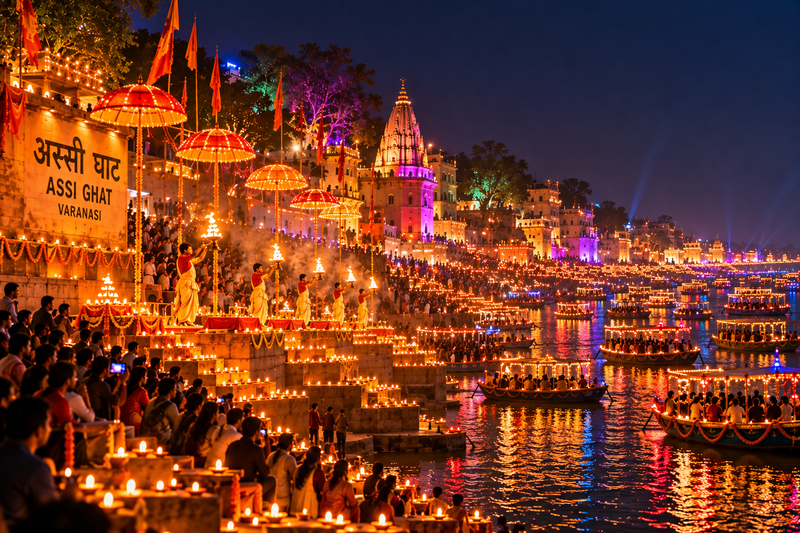
Fifteen days later, on Kartik Purnima, Varanasi has the last word. Dev Deepawali on Tuesday 24 November lines every ghat of the Ganga with lamps, the gods' own Diwali, and it may be the most beautiful night of the whole season.
Keeping it
If the recognition means anything for an ordinary household, it is permission to do the old things properly. Cleaning before Diwali clears out the old year: it is a way of removing negativity and making room for Lakshmi. Do the deep work in the last week of October so the days just before 6 November are free for shopping and decorating. Choosing local potters, florists, sweet-makers and craftspeople keeps the money in your own neighbourhood. Set aside a share of the festival budget for people who need it: sweets, clothes or diyas for families who cannot buy them. Think about the person, not the price: a puja set for parents, a small personalised piece of jewellery for a sibling, a warm blanket for grandparents, or something handcrafted and a box of local delicacies. The thought behind it is what is remembered.
And on the night, open the door. That is the oldest instruction of all: Lakshmi visits the house that is lit and waiting.
Sources
- UNESCO, announcement of the inscription of Deepavali, 10 December 2025.
- Drik Panchang, Lakshmi Puja, Dhanteras and Govardhan Puja timings for 2026.
- All India Radio News, Deepotsav 2025 Guinness World Record report, 19 October 2025.
Comments
How is your family celebrating Deepawali 2026? Readers' notes appear here after review.
No comments yet.